Introduction
Most people learn something new but never actually use it. They read books, watch tutorials, orsit through training sessions, only to forget most of the information within days. This happens because traditional education separates learning from doing. You study first, then much later, you try to apply. That gap is where knowledge dies. Duaction offers a different path. The word itself comes from combining “dual” and “action,” meaning two actions happening together. But duaction is not about doing two unrelated things at once. Instead, it describes the process of learning and applying that knowledge at the same time.
Think of a child learning to ride a bike. No one gives them a lecture on balance for an hour before letting them touch the bicycle. They learn by getting on, wobbling, adjusting, and trying again. That is duaction in its purest form. Traditional methods fail because passive learning creates weak memory traces. Your brain does not treat a lecture the same way it treats a real experience. Duaction closes this knowing-doing gap by forcing immediate use of new information. The core promise is simple: you learn faster, remember longer, and actually build skill instead of just collecting facts.
The History and Evolution of Dual-Action Concepts
Duaction may sound like a modern buzzword, but its roots run deep in educational psychology. In the 1980s, psychologist David Kolb developed Experiential Learning Theory, which argued that people learn best through a cycle of concrete experience, reflection, and application. Kolb showed that experience alone is not enough. You have to act on that experience. Later, researchers like Jean Lave and Etienne Wenger introduced “situated learning,” the idea that learning naturally happens within the activity itself. Apprenticeships, medical residencies, and flight simulators all follow this principle.
You do not learn surgery from a textbook and then operate on a patient. You learn by doing under supervision. In today’s fast-paced digital world, duaction has become more relevant than ever. Information doubles every few years, and traditional courses cannot keep up.Professionals cannot afford to spend weeks in training before returning to work. Duaction fits the modernreality where you learn a small piece, apply it immediately, and move forward. Companies like Google and Tesla already train employees using this model. They know that sitting in a classroom is no longer enough.
The Duaction Framework: The Learn-Act-Reflect Cycle
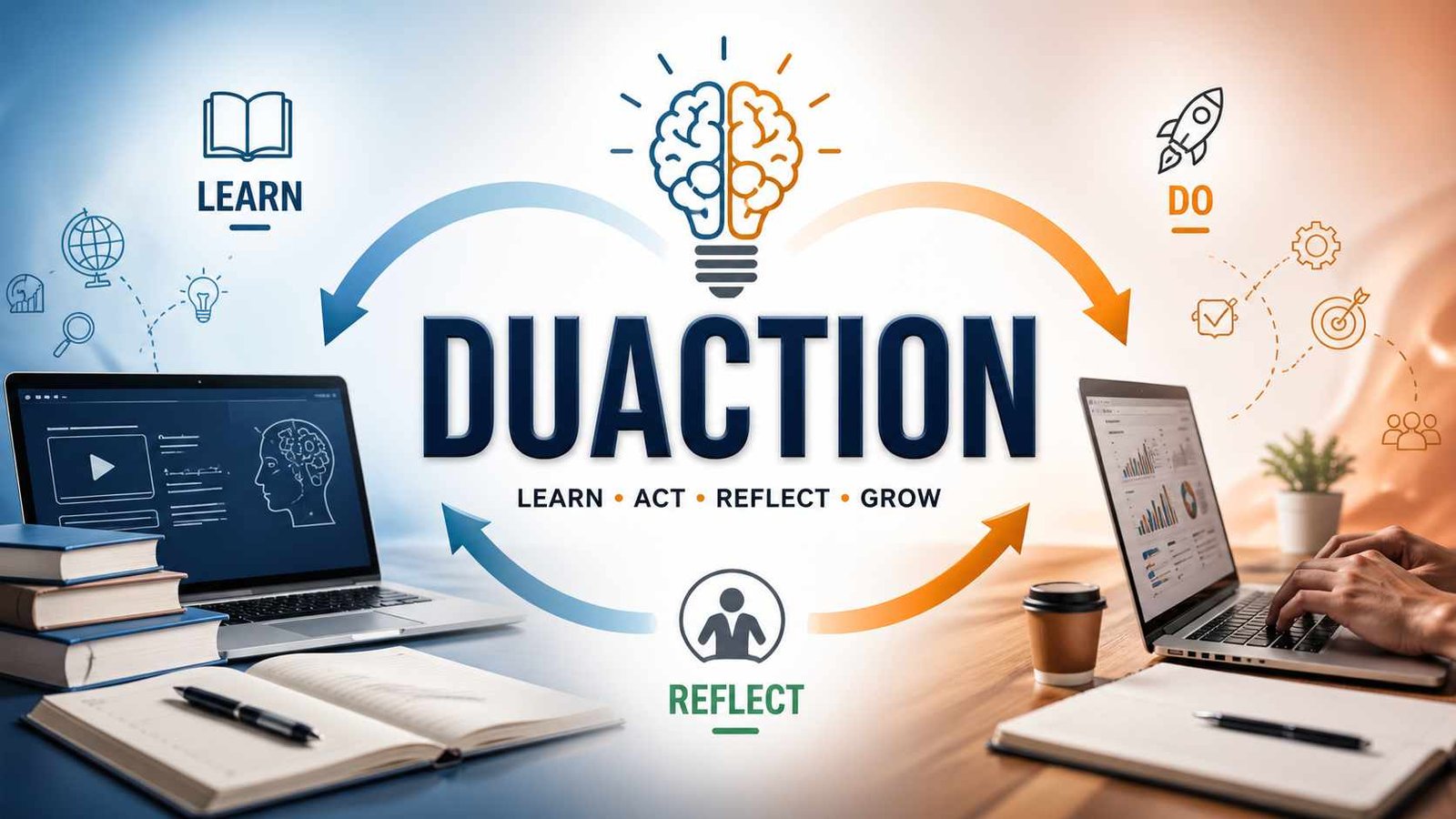
Duaction is not a vague idea. It follows a clear, repeatable cycle that anyone can use. The first step is to absorb a small, specific piece of knowledge. Notice the word small. Your brain can only hold so much new information at once. Instead of watching a two-hour tutorial, take just one concept. For example, if you are learning a new software tool, focus only on how to save a file. That is your learn step. The second step is to immediately apply that knowledge in a real or realistic scenario. Do not wait. Do not take notes for later. Open the software and save a file right now. This immediate action forces your brain to move information from short-term memory into active use. The third step is to analyze the feedback and adjust. Did saving the file work? If yes, great. You have learned something solid. If not, you discovered a gap.
Your file did not save? Now you know exactly what question to ask. This feedback loop is the secret to why duaction works so well. Every time you complete this cycle, your brainstrengthens the neural pathways connected to that skill. Neuroscientists call this process myelination. The more you repeat the learn-act-reflect cycle, the faster and more automatic the skill becomes. Over time, duaction rewires your brain for long-term retention, not just short-term test passing.
Why Duaction is a Game-Changer for Modern Learners
Duaction benefits every type of learner, not just those who prefer hands-on activities. Visual learners, who remember what they see, gain because they watch a short demo and immediately try it themselves. Auditory learners, who learn by listening, benefit from hearing instructions and then speaking or explaining the action to someone else. Kinesthetic learners, who need physical movement, finally get the active practice they have always craved. Beyond learning styles, duaction accelerates skill development dramatically. Most people suffer from what experts call the “knowing-doing gap.” They know what to do, but they cannot do it.
A salesperson knows the script but freezes on a call. A programmer understands loops but cannot write one without looking up syntax. Duaction closes this gap by making action the default. You never learn something without using it, so you never develop the habit of passive consumption. Engagement also rises because duaction feels like progress. Sitting through a lecture feels passive and endless. But taking small actions gives you tiny wins every few minutes. These wins release dopamine, the chemical linked to motivation and pleasure. Suddenly, learning is not a chore. It becomes a rewarding game. Retention rates under duaction can reach seventy-five percent or higher, compared to just five percent for traditional lectures. That difference changes everything for students, employees, and self-directed learners.
Duaction vs. Multitasking: What is the Difference?
Many people confuse duaction with multitasking, but they could not be more different. Multitasking means trying to do two unrelated things at the same time. You listen to a podcast while answering emails. You watch a video while cooking dinner. Your brain cannot actually focus on both. Instead, it rapidly switches attention back and forth. Each switch costs time and mental energy. Research shows that multitasking reduces productivity by up to forty percent and increases mistakes. Duaction, on the other hand, involves doing two things that naturally support each other. Learning and applying the same concept is not divided attention.
It is integrated attention. When you learn a chord on guitar and then play it immediately, you are not switching tasks. You are completing one task: building muscle memory. This integrated approach actually reduces cognitive load because you are not storing information for later retrieval. You are using it now. There is a famous saying that applies here: slow is smooth, and smooth is fast. Duaction feels slower at first because you are not rushing through content. You stop after every small lesson to practice. But long-term, you move faster because you never have to relearn what you forgot. Multitasking makes you feel busy but accomplishes little. Duaction makes you feel focused and builds real skill.
Real-Life Examples of Duaction in Action
Duaction appears everywhere once you start looking for it. In corporate training, companies are moving away from all-day seminars toward role-playing scenarios. Employees learn a sales technique for five minutes, then immediately practice it with a colleague who gives live feedback. This method has been shown to improve retention by over sixty percent compared to lecture-only training. In language learning, the most successful apps use a duaction model. You see a new word, hear it pronounced, and then must construct a sentence using that word within seconds. This forces your brain to retrieve and use the vocabulary before it fades. In coding bootcamps, instructors teach one command, then students write code using that command before moving on. The old model taught syntax for hours before any keyboard touching.
The duaction model produces job-ready coders in weeks, not months. In personal fitness, duaction looks like learning the name and function of a muscle, then immediately performing the exercise that targets it. Understanding why a squat works makes you perform it better. In music education, students learn a scale pattern on paper and then play it on their instrument without delay. Reciting the note names while fingering them creates a powerful mental link between theory and physical action. These examples share one thing: learning and doing are never separated by more than a few seconds.
Duaction Beyond Education (Technology and Medicine)
The concept of duaction extends beyond human learning into technology and medicine. In computing, dual-action processors and smart devices perform two functions at once for efficiency. A printer that scans a document while printing another uses a form of duaction. The machine does not stop one task to start another. It integrates them. In smartphone design, chips now handle touch input and display rendering simultaneously, creating seamless user experiences. Medicine also offers an important clarification. Some readers searching for “duaction” may actually be looking for “Duac,” a prescription gel used to treat acne.
Duac contains clindamycin and benzoyl peroxide, two active ingredients that work together to kill bacteria and clear pores. That is a dual-action medication, but it has nothing to do with the learn-do method of duaction. Spelling confusion happens often. If you are looking for acne treatment, stop reading and consult your pharmacist. But if you want to close the gap between knowing and doing, duaction is the concept you need. Recognizing this distinction also helps website owners understand their audience. Someone typing “duaction” could want educational content or medical information. A strong article addresses both possibilities clearly to avoid frustrating readers.
The Psychology Behind Duaction: The Ripple Effect
Every action creates a reaction. That simple physics law also applies to how we learn and grow. When you apply a small piece of knowledge immediately, you do not just learn a skill. You change how you see yourself. You become someone who acts, not someone who just collects information. Psychologists call this self-efficacy, the belief that you can succeed at specific tasks. Duaction builds self-efficacy faster than any other method because you constantly prove to yourself that you can learn and do. But the ripple effect goes deeper. Each small duaction influences your environment and the people around you. A manager who learns a new communication technique and uses it in the next team meeting changes the meeting’s outcome.
A student who learns a math concept and explains it to a friend helps that friend learn too. Over time, these small choices compound. This is the butterfly effect of duaction. A tiny action today, like practicing a five-minute skill instead of watching another video, can lead to a completely different career path six months from now. Most people overestimate what they can do in a day but underestimate what they can do in a year. Duaction works because it focuses on the daily micro-actions that create massive long-term change. You do not need to revolutionize your whole life at once. You just need to learn one thing and do it right now.
How to Implement Duaction in Your Daily Routine
Implementing duaction does not require special tools or extra hours in your day. You simply change how you approach learning. Step one is to identify one specific skill you want to learn. Do not choose something vague like “become a better speaker.” Choose something measurable like “remember names when meeting new people.” Clarity is the foundation of duaction. Step two is to break that skill into micro-actions using the twenty-minute rule. No learning session should last longer than twenty minutes before you act. For remembering names, the micro-action might be learning one memory technique, such as repeating the name three times in your head. That takes thirty seconds to learn. Step three is to find a sandbox where you can fail safely. A sandbox is a low-pressure environment where mistakes have no real cost.
For public speaking, your sandbox might be a supportive book club. For coding, an online coding playground. For cooking, a weekend afternoon when burned food does not ruin dinner. Duolingo works so well because it is a sandbox for language. You cannot offend anyone by saying the wrong word. Step four is to schedule reflection time. At the end of each day, spend five minutes asking yourself what stuck and what did not. This reflection closes the loop. Without it, you repeat the same mistakes. With it, you improve continuously. Duaction is not about perfection. It is about a steady rhythm of learn, act, reflect, and repeat.
Overcoming Common Duaction Obstacles
Even with the best intentions, duaction faces real obstacles. The first and biggest is fear of failure. Many people avoid immediate action because they are afraid to look stupid. They want to learn more before trying. This fear is understandable but harmful. The only way to overcome it is to change your environment, not your personality. Create low-stakes testing situations. Practice a new language with a patient friend instead of a native speaker. Try a new software trick on a copy of the file, not the original. These low-stakes environments give you permission to fail without real consequences. Over time, your brain learns that failure is just feedback, not a judgment of your worth. The second obstacle is lack of resources or mentors. Not everyone has a coach or teacher available for immediate feedback. But modern technology offers solutions.
Digital twins and AI simulation tools can fill this gap. Language apps provide instant corrections. Coding platforms run your code and show errors immediately. Even AI chatbots can act as practice partners for sales or customer service conversations. These tools are not perfect, but they are better than doing nothing. The third obstacle is time pressure. People feel too busy to stop and practice. But duaction actually saves time because you are not relearning forgotten material. Start with just one five-minute duaction per day. That small commitment builds the habit. Once the habit forms, you naturally find more opportunities to apply duaction throughout your day.
The Future of Duaction: Why Smart Progress Beats Busy Work
The future of work and education is moving toward integrated workflows. Traditional models that separate training from production are simply too slow. Companies cannot afford to pull employees off the floor for week-long courses. Schools cannot afford to teach theory for four years without real-world application. Duaction offers a better path. Instead of learning everything and then doing, we will learn small pieces and do them immediately. This shift from linear learning to embedded learning is already happening in high-performing organizations. Medical students learn procedures on simulators and then perform them with supervision on the same day. Engineering students build prototypes while taking design courses.
Customer support agents learn product updates in the morning and take live chats in the afternoon. The final verdict is clear. Embracing the learn-do lifestyle of duaction is not just a nice idea. It is becoming a competitive necessity. Those who master duaction will adapt faster, solve problems quicker, and retain skills longer. Those who stick to passive learning will fall behind. Duaction does not require genius or natural talent. It requires a simple willingness to act on what you learn, right now, before the knowledge slips away.
FAQ’s
1. What is duaction in simple words?
Duaction means learning something and applying it immediately.
2. Is duaction part of modern education?
Yes, it is closely linked with modern skill-based learning systems.
3. Why is duaction important?
Because it improves skills, memory, and real-world performance.
4. Can duaction replace traditional education?
No, but it can strongly improve it when combined.
5. Who benefits most from duaction?
Students, professionals, and skill-based learners.
Conclusion
Duaction transforms how we learn by removing the gap between study and practice. Instead of collecting information you will forget, you build real skills you can use. The learn-act-reflect cycle works for students, professionals, artists, and athletes alike. It fits into busy schedules through micro-actions of five to twenty minutes. And it overcomes common obstacles like fear of failure through low-stakes sandboxes and AI tools. Whether you want to learn a language, master software, or improve public speaking, duaction gives you a clear, repeatable path forward. Stop waiting until you feel ready. Start your first duaction cycle today. Learn one small thing, do it immediately, and watch how quickly smart progress beats busy work.