Introduction
Axurbain is a modern urban concept that represents the future of how cities are designed, managed, and experienced. It combines ideas from technology, sustainability, and human-centered planning to create smarter and more efficient urban environments. The word “axurbain” is believed to come from two parts: “Axis,” meaning direction or structure, and “Urbain,” a French word for urban. Together, they represent a structured and forward-moving vision of city development.
In recent years, axurbain has started appearing in discussions about smart cities, digital transformation, and modern urban innovation. It is often used in tech blogs, lifestyle platforms, and urban design conversations to describe cities that are intelligent, connected, and sustainable. While it is not an official global standard, axurbain has become a symbolic term for future-ready urban systems.
Today, as cities face challenges like overcrowding, pollution, and infrastructure pressure, axurbain offers a conceptual solution for building better living spaces. It focuses on using technology and human-centered design to improve quality of life and long-term sustainability.
Meaning of Axurbain
At its core, axurbain represents a smart city and urban transformation framework designed to improve how cities function. It is not just about technology it is about creating balance between people, nature, and innovation. The idea is to build cities that are not only efficient but also livable and environmentally responsible.
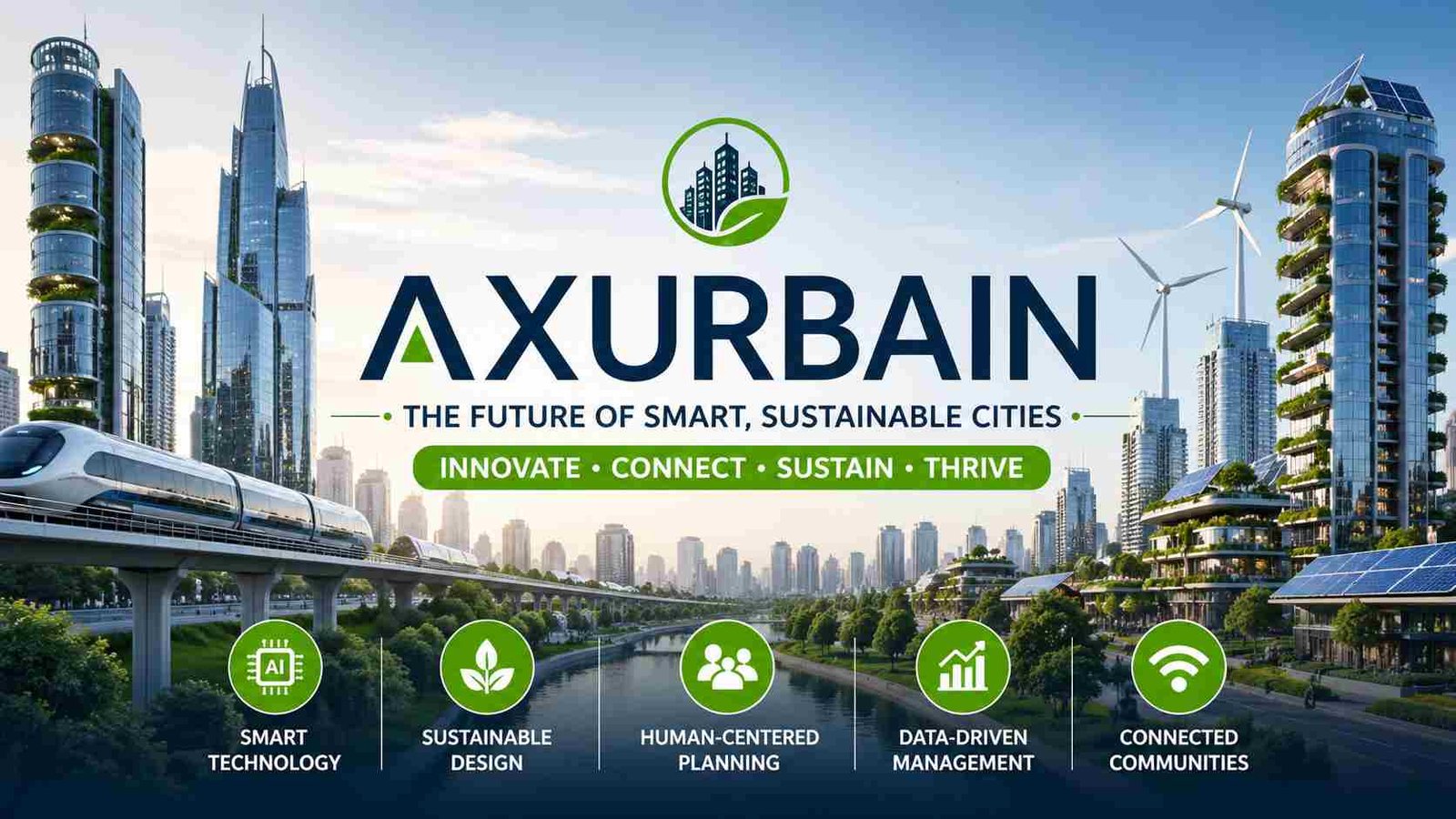
Axurbain integrates three main pillars. First is technology, which includes artificial intelligence (AI), Internet of Things (IoT) systems, and digital infrastructure that helps cities operate smoothly. Second is sustainability, which focuses on eco-friendly designs, renewable energy use, and reducing environmental impact. Third is human-centered development, which ensures that cities are designed for people, encouraging comfort, accessibility, and community interaction.
Together, these elements form a holistic urban evolution model. Axurbain is not limited to buildings or roads it includes how transportation, energy, communication, and public services work together in harmony. It imagines a future where cities are intelligent ecosystems that adapt to human needs in real time.
Origin and Background of Axurbain
The term axurbain is a combination of linguistic and conceptual influences. “Ax” represents axis or direction, symbolizing structure and forward movement, while “Urbain” comes from French, meaning urban or city-related. This combination reflects the idea of structured urban evolution guided by innovation.
Axurbain did not originate from a single organization or inventor. Instead, it emerged from digital discussions around smart cities, sustainability, and future technology. Over time, bloggers, tech writers, and urban thinkers began using the term to describe advanced city models that go beyond traditional planning systems.
Its popularity grew mainly through online platforms where future cities and innovation trends are discussed. However, there is still debate about whether axurbain is a formal urban development model or simply a marketing-driven concept used for SEO and branding purposes. Despite this, the idea continues to attract attention because it represents modern urban aspirations.
Key Principles of Axurbain
Axurbain is built on several foundational principles that guide its vision of future cities.
One of the most important principles is smart technology integration. This includes AI-powered systems that manage traffic, security, and public services. IoT devices collect real-time data to help cities operate efficiently and respond quickly to changes.
Another principle is sustainability and green urban design. Axurbain promotes renewable energy sources, energy-efficient buildings, and green public spaces that reduce environmental impact and improve air quality.
Human-centered urban planning is also essential. This means designing cities that are walkable, accessible, and community-friendly. Mixed-use neighborhoods where people can live, work, and relax in one area are a key part of this idea.
Finally, data-driven city management plays a major role. Cities under the axurbain concept use predictive analytics, smart traffic systems, and digital twins to simulate and improve urban performance. This makes decision-making faster and more accurate.
How Axurbain Works (Urban System Model)
Axurbain functions as an interconnected urban ecosystem where all systems work together in real time. Instead of treating transport, housing, energy, and communication as separate sectors, axurbain integrates them into one intelligent network.
For example, transportation systems are connected to traffic data and AI algorithms that adjust signals automatically. Housing developments are designed based on population trends and environmental data. Energy systems are optimized to reduce waste and improve efficiency.
Communication networks ensure that citizens stay connected with public services instantly.
The key strength of axurbain lies in its ability to use real-time data for decision-making. Sensors placed across the city collect information that is analyzed instantly. This allows governments and city planners to adapt quickly to changing conditions.
In simple terms, axurbain works like a living digital organism always learning, adjusting, and improving based on how people interact with the city.
Features of Axurbain Cities
Cities designed under the axurbain concept include several advanced features that make them more efficient and livable.
Smart mobility systems ensure smooth transportation using AI-powered traffic control and electric vehicles. Eco-friendly buildings are designed to reduce energy consumption and environmental impact. Digital governance systems allow citizens to access services online without long delays.
AI-based city management helps authorities monitor infrastructure and respond to issues quickly. Sustainable resource usage ensures that water, electricity, and materials are used efficiently. Connected public services allow citizens to interact with hospitals, transport systems, and government offices through digital platforms.
These features work together to create a highly organized and responsive urban environment.
Benefits of Axurbain Concept
The axurbain model offers many benefits for modern cities. One of the biggest advantages is reduced pollution due to the use of clean energy and smart transportation systems.
Traffic management becomes more efficient, reducing congestion and travel time. People experience an improved quality of life because cities are cleaner, safer, and more organized.
Energy efficiency is another major benefit, as smart grids reduce waste and optimize usage. Stronger community engagement is encouraged through digital platforms and shared public spaces.
Overall, axurbain supports faster and more sustainable urban development, making cities more adaptable to future challenges.
Challenges and Criticism of Axurbain
Despite its positive vision, axurbain also faces several challenges. One major issue is the lack of official global recognition. It is not yet a formally defined urban planning model used by governments.
Another challenge is limited real-world implementation. While similar ideas exist in smart cities, axurbain itself is still largely conceptual.
Some critics believe the term is overused in marketing and SEO content without strong technical backing. There is also a need for scientific validation to prove how effectively such a system can work at a large scale.
These challenges show that while axurbain is an inspiring idea, it still requires development and practical testing.
Axurbain vs Traditional Urban Planning
| Feature | Traditional Cities | Axurbain Cities |
| Infrastructure | Fixed and rigid | Flexible and adaptive |
| Sustainability | Limited focus | High priority |
| Mobility | Car-dependent | Smart transport systems |
| Technology Use | Minimal integration | Fully digital ecosystem |
| Planning Style | Manual & slow | Data-driven & AI-powered |
Traditional urban planning focuses more on static structures, while axurbain emphasizes dynamic, intelligent systems. This makes axurbain more suitable for future urban challenges.
Real-World Examples Similar to Axurbain
Although axurbain itself is conceptual, several cities reflect similar ideas. Singapore is known for its advanced smart infrastructure and digital governance. Copenhagen focuses heavily on sustainability and green energy solutions.
Barcelona has implemented smart mobility systems to improve traffic flow and public transport efficiency. Seoul is also a strong example, using digital solutions for urban management and citizen services.
These cities show that while axurbain may not exist as a formal model, its principles are already being applied in real life.
Axurbain in Digital and Tech Industry
In the digital world, axurbain is often used in blogs, tech websites, and branding content to describe futuristic city ideas. It has also become part of SEO keyword strategies related to smart cities and urban innovation.
Content creators use axurbain to attract audiences interested in future technology and urban planning. It is also linked to smart city marketing campaigns that promote innovation and sustainability.
In many ways, axurbain acts as a digital storytelling concept that helps explain complex urban ideas in a simple and engaging way.
Future of Axurbain (2026 and Beyond)
The future of axurbain looks closely tied to the global growth of smart cities. As AI technology continues to evolve, urban planning will become more automated and data-driven.
Cities are expected to become more sustainable, using renewable energy and eco-friendly infrastructure. AI will play a bigger role in predicting urban needs and improving city operations.
There is also a possibility that axurbain-like systems could become formal frameworks in the future as governments adopt more advanced urban technologies.
Is Axurbain Real or Just a Concept?
Axurbain currently exists in a gray area between concept and interpretation. Some sources describe it as an innovation model for future cities, while others see it as a digital or SEO-driven term.
There is no official institution or government that has defined axurbain as a real-world system. However, the ideas behind it are very real and are already influencing modern urban development.
So, axurbain is best understood as a conceptual framework that represents future city innovation rather than a fully established system.
Key Terms for Better Ranking
To improve search visibility, the keyword “axurbain” should be used naturally throughout the article along with related terms. These include axurbain meaning, what is axurbain, axurbain smart city, axurbain concept explained, axurbain urban planning, future cities axurbain, and axurbain technology.
Using these keywords in headings, subheadings, and body text helps search engines understand the topic clearly. However, keyword stuffing should be avoided to maintain readability and user experience.
The goal is to create natural, informative content that answers user intent. When people search for axurbain, they are usually looking for explanations, comparisons, and future insights. This article structure ensures all those needs are covered in a clear and organized way.
FAQ’s
1. What does Axurbain mean?
Axurbain refers to a modern urban concept combining smart technology, sustainability, and human-centered city design.
2. Is Axurbain a real city model?
No, it is not an official city model but a conceptual idea representing future urban innovation.
3. Who created Axurbain?
There is no single creator; it emerged from digital discussions about smart cities and urban planning.
4. How does Axurbain work?
It works by integrating AI, IoT, and data systems to manage cities as connected ecosystems.
5. Is Axurbain used in real cities?
While the exact term is not used officially, many cities apply similar smart city principles
Conclusion
Axurbain represents a forward-thinking vision of future cities where technology, sustainability, and human needs work together. Although it is still a conceptual idea, its principles are already shaping modern urban development. From smart transportation to eco-friendly infrastructure, axurbain highlights how cities can become more efficient and livable. As technology continues to grow, this concept may evolve into more structured frameworks that influence real-world urban planning in the future.