
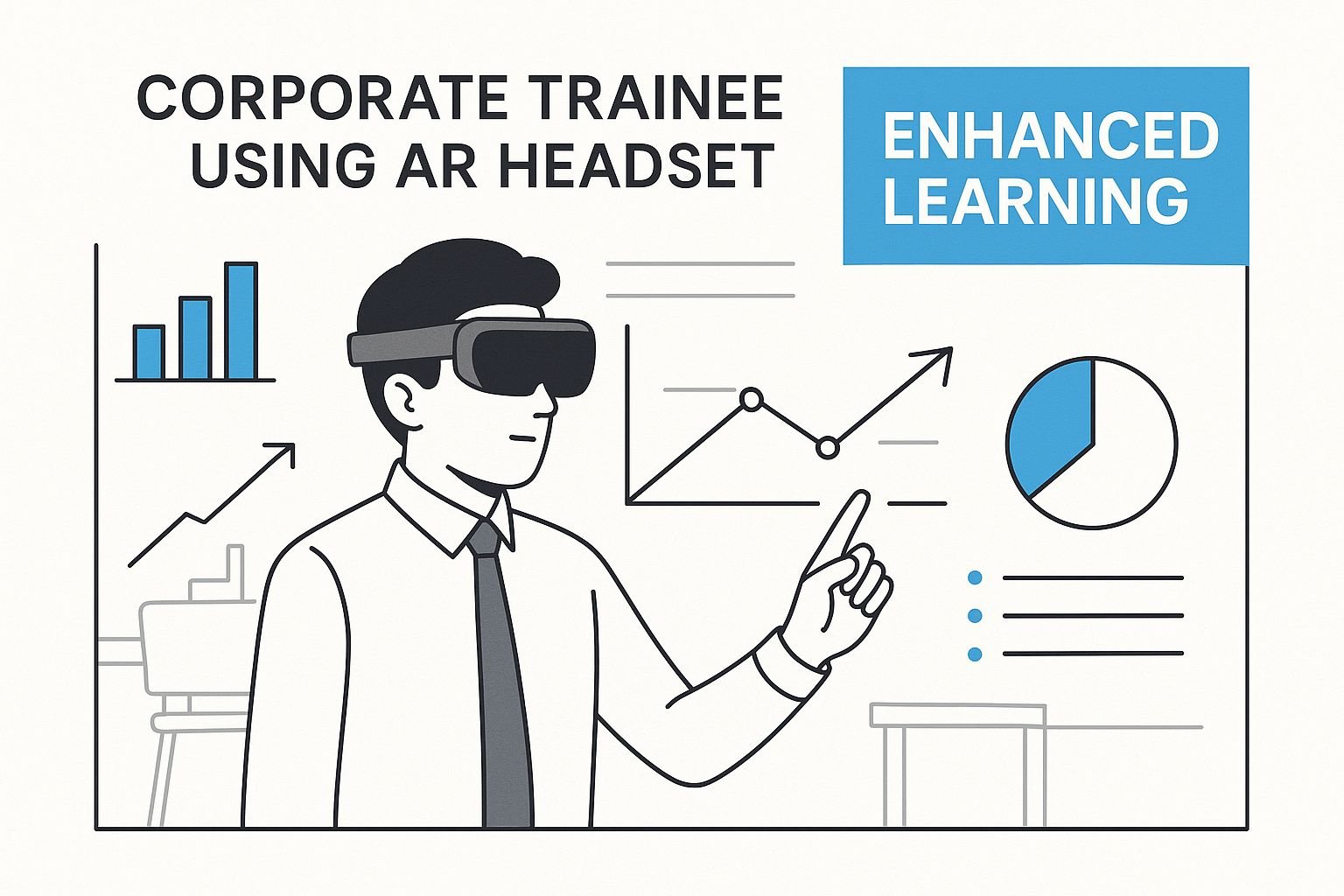
Businesses are no longer looking at augmented reality as a novelty within digital products. It is being considered more seriously as a useful enterprise capability that can support training, improve product presentation, make field work easier, and create better customer interactions. This growing attention is strongest where visual context adds real operational value.
For B2B decision-makers, the appeal is becoming clearer:
- It can reduce friction in product understanding and guided workflows.
- It helps teams present information in a more usable and contextual format.
- It supports better engagement across customer, workforce, and service environments.
- It aligns with broader enterprise priorities around efficiency, accuracy, and experience design.
How Augmented Reality in Business Supports Customer Experience
One major reason augmented reality in business is attracting attention is its ability to make digital interactions more tangible. In sectors where customers need clarity before purchase, AR can help buyers understand scale, fit, configuration, and usage more confidently. That makes it especially relevant for industries such as retail, real estate, automotive, manufacturing, and B2B product sales. Reports focused on retail and immersive commerce continue to position AR as a tool for stronger product understanding and conversion support.
Common customer-facing use cases include:
- Virtual product previews before purchase.
- Interactive product demonstrations in sales journeys.
- Guided visual support within mobile commerce experiences.
- Better post-purchase onboarding and product education.
This is one reason many firms are exploring augmented reality development services as part of broader digital experience planning.
Where Augmented Reality in Business Fits Into Workforce Training
Augmented reality is becoming more useful to businesses because it can make workforce training more practical. Many training processes are difficult to manage consistently and still depend heavily on direct supervision. By placing visual instructions into the real work environment, AR can help teams perform technical or safety-focused tasks with greater clarity.
Business value often comes from:
- Faster onboarding for operational roles.
- More consistent training across distributed teams.
- Better retention through visual and interactive learning.
- Reduced dependency on manuals or repeated live demonstrations.
This enterprise interest is consistent with broader XR research that highlights training, workplace productivity, and operational support as meaningful areas of adoption.
Why Augmented Reality in Business Matters for Operations and Service
For many enterprises, the value of augmented reality becomes clearer when it supports day-to-day operations rather than only customer-facing experiences. In areas such as field service, maintenance, logistics, and industrial work, it can help teams carry out tasks more accurately and with less interruption by bringing relevant guidance directly into the work environment.
Operational advantages may include:
- Faster issue identification in service workflows.
- Improved remote collaboration for technical teams.
- Better use of asset data in physical environments.
- Visual assistance during installation and maintenance.
Enterprise moves around digital reality and industrial visualization also suggest that spatial and contextual interfaces are gaining relevance in asset-heavy industries.
What Is Driving Augmented Reality in Business Trends Now
The current momentum around augmented reality in business is not coming from hype alone. It is being shaped by a few practical market forces. Businesses are looking for better ways to connect digital systems with physical workflows. They also want product experiences that are more interactive, more informative, and easier to scale across channels.
Current trend drivers include:
- Greater enterprise focus on immersive training and guided work.
- Stronger interest in spatial computing and contextual interfaces.
- Growth in retail and commerce use cases for visual buying support.
- Better integration between 3D content, mobile platforms, and enterprise systems.
Recent industry reports point to expanding enterprise applications, improving hardware environments, and stronger cross-industry adoption patterns.
What Enterprises Should Evaluate Before Adopting Augmented Reality in Business
Stronger market interest does not remove the need for careful assessment. In business settings, augmented reality is only valuable when it supports a clear commercial or operational purpose. Instead of adopting it for visibility or novelty, companies should examine where it can deliver a practical solution to an existing challenge.
Key evaluation points include:
- Whether the experience improves a measurable business process.
- How well it fits existing systems and content workflows.
- The cost of building, maintaining, and scaling the experience.
- Device accessibility across customer or workforce environments.
- Governance around content accuracy, privacy, and security.
A well-planned approach becomes important at this stage. Some businesses also align AR projects with game development services when they need deeper 3D capability, simulation-focused thinking, or more immersive interface design.
How Augmented Reality in Business Can Shape Long-Term Enterprise Value
The long-term relevance of augmented reality in business lies in its practical role as a bridge between physical environments and digital intelligence. Enterprises are under pressure to improve both efficiency and experience. AR stands out because it can support both when applied to the right use cases. It helps information become more visible, decisions become more contextual, and interactions become more intuitive.
For enterprise leaders, the real opportunity is not simply to deploy immersive technology. It is to identify where augmented reality in business can improve customer understanding, workforce capability, or operational clarity in a way that is scalable and commercially useful. Businesses that approach it with that discipline are more likely to turn AR into a meaningful part of enterprise strategy rather than a short-lived experiment.